

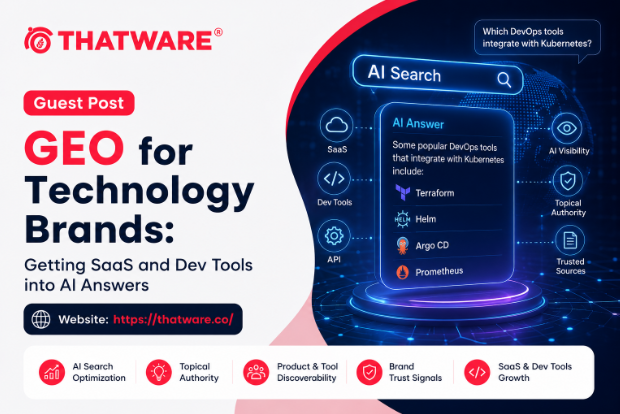
There’s an interesting irony in the tech industry’s relationship with AI search. Technology brands — SaaS companies, developer tools, cloud platforms — are probably more dependent on AI-mediated discovery than any other category. Their buyers are sophisticated, research-driven, and increasingly starting that research with AI assistants. And yet many of these brands are doing the least to optimize for AI citation.
Part of this is understandable. Tech marketers tend to focus on SEO, G2 reviews, and content marketing to developer communities. These are all still valid. But as AI systems become the first filter for software evaluation, the brands that show up there will have a significant pipeline advantage.
How Developers and Buyers Use AI for Software Research
The AI search patterns in B2B tech are distinct and worth understanding specifically.
Developers ask highly technical queries: “best open-source vector database for production use cases,” “how does [product] handle concurrent connections at scale,” “what are the limitations of [tool] for streaming data.” These queries require specific, technically accurate answers — and the sources AI systems cite for them tend to be technical documentation, developer blogs, and independent technical evaluations, not marketing pages.
Business buyers ask comparison and evaluation queries: “how does [Product A] compare to [Product B] for enterprise use,” “what do G2 reviews say about [product’s] customer support,” “is [vendor] SOC 2 compliant.” These queries draw from review platforms, industry analyst reports, and trusted tech publications.
Understanding these two query types — and the different content and authority signals they require — shapes a genuinely useful tech GEO strategy.
Technical Documentation as GEO Infrastructure
For developer-facing products, technical documentation is a massive, underutilized GEO asset. Well-written docs — with clear explanations, specific examples, and structured content — are exactly what AI systems pull from when answering technical queries.
The challenge is that many product docs are written primarily for users who already know why they’re there. Adding context — explaining why a feature exists, what problems it solves, how it compares to alternative approaches — transforms documentation from a user resource into a citable reference for AI systems answering evaluation queries.
API reference documentation with clear use case descriptions, quickstart guides that walk through specific real-world scenarios, architecture guides that explain design decisions — these are all AI citation material if they’re written with the right depth and specificity.
Best GEO agency for SaaS / B2B / eCommerce firms that work with developer-facing products understand this documentation-as-GEO-content play and know how to optimize technical content for AI citability without sacrificing the precision that developer audiences require.
Category Positioning in AI Responses
One of the most strategically important GEO questions for SaaS brands is: when AI systems are describing your product category, do they mention you? And if they do, is the positioning accurate?
This sounds simple but is often not. AI models may have representations of your category that are outdated, or that position you in a competitive context that doesn’t reflect your current positioning. A product that has evolved significantly over the past two or three years may still be represented by AI systems based on earlier descriptions.
Proactively managing this means regularly testing category queries across major AI platforms — “what are the best [category] tools for [use case]” — and understanding how your brand appears (or doesn’t). When the representation is wrong, the remediation involves updating how you describe yourself across all owned and earned channels consistently, so the model encounters a coherent, current picture.
G2, Capterra, and Review Platform Integration
For SaaS brands, software review platforms are a specific and important AI authority signal. These platforms — G2, Capterra, Trustpilot, Product Hunt — are heavily represented in AI training data and retrieval datasets. The content they contain about your product shapes how AI systems describe it.
This creates specific action items. Actively managing your presence on these platforms — with complete, accurate, up-to-date product descriptions, a healthy volume of authentic reviews, and consistent vendor responses — is not just review management, it’s GEO infrastructure.
The review content itself matters for AI citation purposes. Reviews that describe specific use cases, specific integrations, specific workflows enabled by the product generate the contextual data AI systems use when matching software to specific evaluation queries. A G2 profile with fifty reviews that all say “great product, easy to use” is less GEO-valuable than one with fifty reviews that describe specific feature sets, specific team sizes and types, and specific problems solved.
Thought Leadership and Category Creation
Tech brands that have successfully built AI citation authority tend to have something in common: they’ve established genuine thought leadership in their category, and that thought leadership has been recognized in publications that carry weight in AI training data.
Industry publications like TechCrunch, Wired, VentureBeat, and category-specific media outlets create the kind of third-party expert coverage that AI systems cite heavily. Analyst coverage from Gartner, Forrester, or IDC — even mentions in reports your company doesn’t commission — is among the highest-authority signal available.
For brands still building toward that level of visibility, the intermediate step is publishing original research and data. A SaaS company that conducts an annual survey of its customer base and publishes the findings becomes a primary data source in its category — and data sources are among the most consistently cited content types in AI responses.
Developer Community Presence
For dev tools specifically, community presence matters in ways that are somewhat unique to this category. Stack Overflow threads that reference your tool, GitHub repositories, developer forum discussions, technical blog posts from independent developers — these represent a distributed web of technical endorsement that AI systems interpret as domain authority.
Actively supporting the developer community — answering questions, contributing to open-source adjacent projects, sponsoring or participating in developer conferences that generate documentation and content — builds this distributed authority over time.
AI-powered search optimization services that understand developer marketing know that community signals and technical content authority are as important as traditional SEO metrics in this category.
The tech brands owning AI search by 2026 are the ones treating documentation quality, review platform presence, technical thought leadership, and community engagement as an integrated GEO program — not separate marketing activities. That integration is where the leverage is.